Tag Archives: science

Nature News

I’ve just wrapped up 16 months as Asia-Pacific Bureau Chief for Nature News. The very excellent Nicky Phillips took an extended parental leave to simultaneously have a baby and attend the Knight Science Journalism Fellowship at MIT, and needed someone to fill her enormous shoes.

What a privilege it was to work with the talented team at Nature News. The journalism at Nature emphasises quality. Unlike so many newsrooms these days, they still have a team of fact-checkers. In the world of the 24-hour news cycle, fact-free opinion, and churnalism, it was a pleasure to work the “old fashioned” way, pursuing balanced, fair and nuanced reporting.

A few highlights from my year and a bit (all paywalled, sorry):

COVID-origins study links raccoon dogs to Wuhan market: what scientists think
by Smriti Mallapaty
https://www.nature.com/articles/d41586-023-00827-2
I was visiting London when we did this story. And Smriti, back home in Australia, stayed up very, very late to get this story over the line.

Polar bear fur-inspired sweater is thinner than a down jacket — and just as warm
by Gemma Conroy
https://www.nature.com/articles/d41586-023-04145-5
Because sometimes (often) science can be fun. And if there is fun to be had, Gemma will find it.

A 27,000-year-old pyramid? Controversy hits an extraordinary archaeological claim
by Dyani Lewis
https://www.nature.com/articles/d41586-023-03546-w
What started as a quirky little story, quickly escalated into a question of whether the journal had erred in publishing the debated claim.

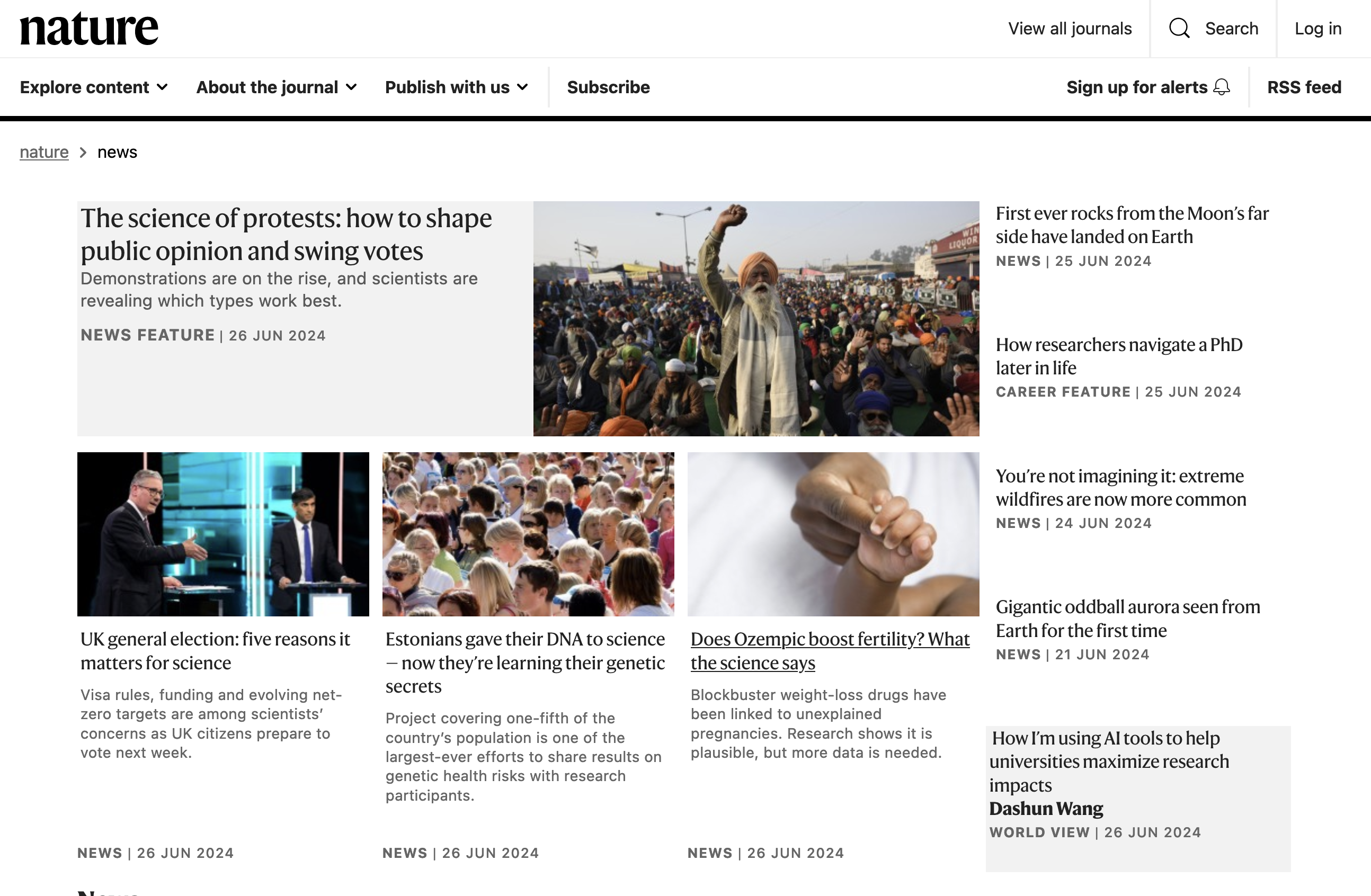
Does Ozempic boost fertility? What the science says
by Gillian Dohrn
https://www.nature.com/articles/d41586-024-02045-w
Each year the APAC Bureau takes on a science journalism student from UC Santa Cruz. This year, Gillian pitched me this idea, and waded through reams of studies to find a story amongst it all.

Plus a huge thanks to the many freelance journalists who contributed stories throughout the year.

The Best Australian Science Writing 2020

Cover of the book Best Australian Science Writing 2020
BASW 2020

Science is a messy business. A product of humans, it has all our flaws. It proceeds in fits and starts. It fails. It goes up dead-ends and gets stuck. It flails hopelessly in confusion. And yet, somehow, through teamwork, perseverance, and often, sheer bloody-mindedness, little wonders emerge.

This year, I had the very great privilege of editing the Best Australian Science writing. What better thing to do in a year of COVID lockdown that to read through hundreds of entries to this anthology. The 33 stories that made it in are shining examples of really, really good science writing. They capture the humanity of science. They capture that messiness, the uncertainty, and they present it honestly.

And who better to write the foreword to such a book than a Nobel-prize winning immunologist? Peter Doherty is not only a great scientist, but an enthusiastic speaker and writer on science for non-experts. His ongoing support for this anthology is evidence of his belief that science is not complete until it’s communicated.

Thanks too, to Merlin Crossley, Jodie Bradby, Helene Marsh and Matthew England for being a reliable go-to scientific committee that vetted the shortlist.

People often ask me what I looked for in “good science writing”. To me, it is a story that is effortless to read; a story that barrels along in such a fascinating manner, you’re sad to reach the end. And when you do, you realise that you have learned a vast amount about a topic you hadn’t even heard of before.

It’s also the research. I like to see evidence that a writer has dug deep to find new gems. Ceridwen Dovey, who won this year’s Bragg Prize for science writing went back to the original Apollo mission logs to check her facts. Runners up Konrad Marshall and Ricky French went into the field, searching for possum poo with researchers, or visiting sterile frog breeding facilities, to secure their stories. Lesley Hughes must have drowned in an ocean of research on synthetic milk production. And John Pickrell added to his already prodigious knowledge of all things palaentological to discuss new research on the ear-bones of early mammals.

But more than anything else, I love the nexus between intellect and emotion in good science writing. Being an intellectual pursuit, you expect a science story to bring you new knowledge. But when science writers wrap that new knowledge in cloak of heartstring-tugs, that’s when they lift science writing to the level that gets them into the annual anthology. To paraphrase every movie trailer ever, the stories in this book will make you laugh, they will make you cry, they will make you wonder at the mysteries of the universe, they will make you rage, they will make you nervous, they will make your heart sing.

Summer is coming in the southern hemisphere. Time to relax and revive. And the northern hemisphere is staring into the face of a long, dark winter of COVID lock down. In both of these circumstances, a good book is the companion you need to get you through to 2021.

Buy your copy here, or in all good bookshops https://www.bookshop.unsw.edu.au/details.cgi?ITEMNO=9781742236841&09540800

What are the odds on climate science?

TOMORROW, IN MELBOURNE’S hallowed ground, the MCG, the rockin’ and rollin’ Dockers will take on the mighty fighting Hawthorn. Who will win? Good question, and there’s a lot of money riding on it.

But let’s pretend for a minute, that you had a super computer that can run a predictive mathematical model, like the one at the headquarters of the Bureau of Meteorology across the CBD on Collins Street. Never mind what the bookies calculate, this machine can do 53,912 gigaflops when it’s really trying.

What data would you punch into the machine? You’d take assessments of how the teams had fared against each other previously, and how they had fared in the kind of weather we expect tomorrow. But the BoM’s computer can take 23 million pieces of input data. So you could punch in a lot more than just that. You could plug in data about each individual player, their injury history, their playing style, their speed and their accuracy.

Let’s pretend that you found 23 million pieces of information about the teams and conditions to plug into the computer and you programmed it to run a simulation of the game.

It says the Dockers win. How confident would you be about the result? You’re right, Hawks fans, let’s run that thing again…

Read more: http://www.abc.net.au/environment/articles/2013/09/27/3858063.htm