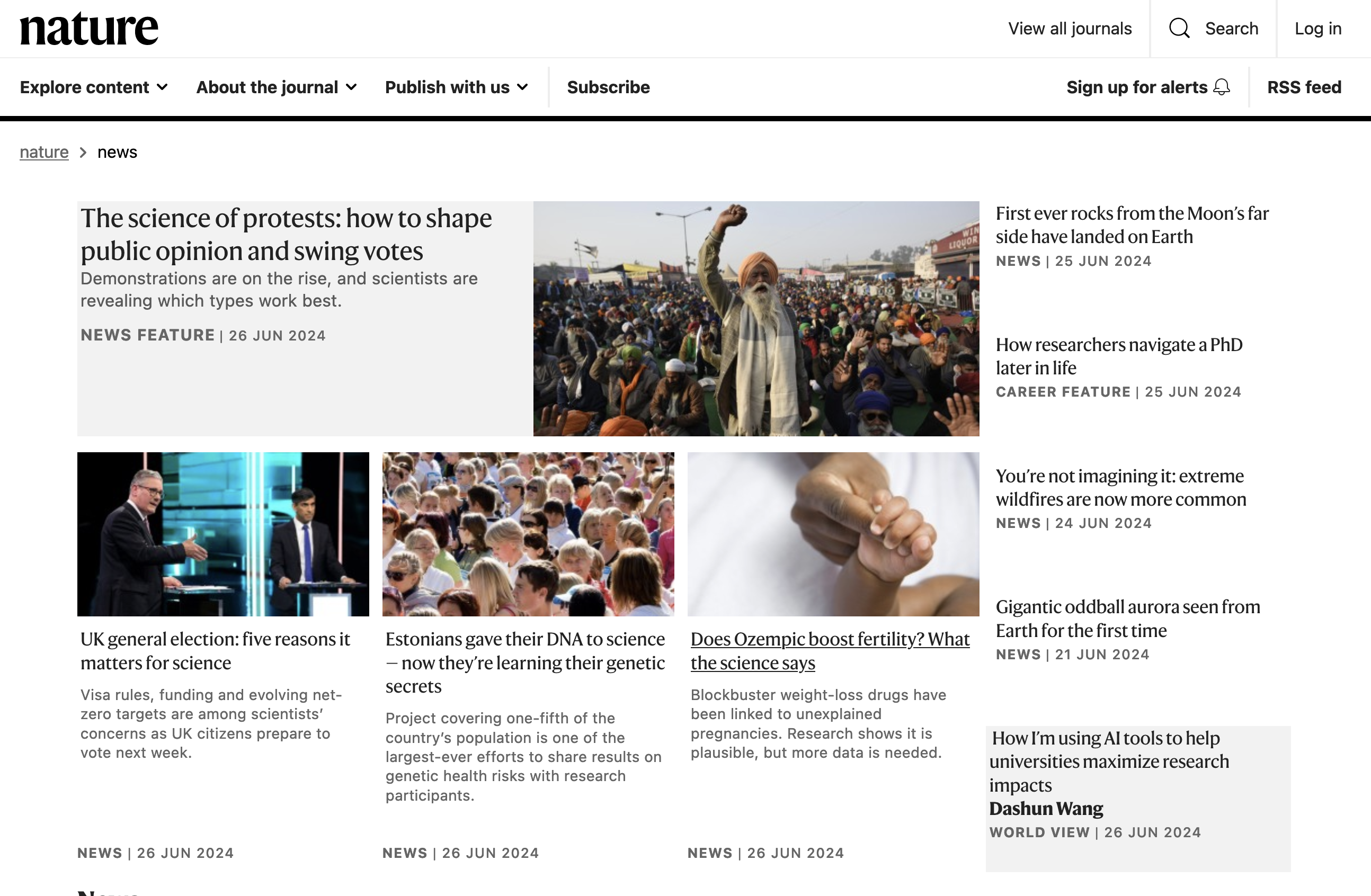
Nature News

I’ve just wrapped up 16 months as Asia-Pacific Bureau Chief for Nature News. The very excellent Nicky Phillips took an extended parental leave to simultaneously have a baby and attend the Knight Science Journalism Fellowship at MIT, and needed someone to fill her enormous shoes.

What a privilege it was to work with the talented team at Nature News. The journalism at Nature emphasises quality. Unlike so many newsrooms these days, they still have a team of fact-checkers. In the world of the 24-hour news cycle, fact-free opinion, and churnalism, it was a pleasure to work the “old fashioned” way, pursuing balanced, fair and nuanced reporting.

A few highlights from my year and a bit (all paywalled, sorry):

COVID-origins study links raccoon dogs to Wuhan market: what scientists think
by Smriti Mallapaty
https://www.nature.com/articles/d41586-023-00827-2
I was visiting London when we did this story. And Smriti, back home in Australia, stayed up very, very late to get this story over the line.

Polar bear fur-inspired sweater is thinner than a down jacket — and just as warm
by Gemma Conroy
https://www.nature.com/articles/d41586-023-04145-5
Because sometimes (often) science can be fun. And if there is fun to be had, Gemma will find it.
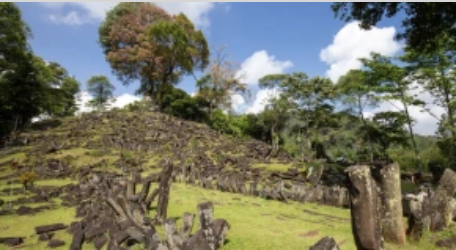
A 27,000-year-old pyramid? Controversy hits an extraordinary archaeological claim
by Dyani Lewis
https://www.nature.com/articles/d41586-023-03546-w
What started as a quirky little story, quickly escalated into a question of whether the journal had erred in publishing the debated claim.

Does Ozempic boost fertility? What the science says
by Gillian Dohrn
https://www.nature.com/articles/d41586-024-02045-w
Each year the APAC Bureau takes on a science journalism student from UC Santa Cruz. This year, Gillian pitched me this idea, and waded through reams of studies to find a story amongst it all.

Plus a huge thanks to the many freelance journalists who contributed stories throughout the year.

The Best Australian Science Writing 2020

Cover of the book Best Australian Science Writing 2020
BASW 2020

Science is a messy business. A product of humans, it has all our flaws. It proceeds in fits and starts. It fails. It goes up dead-ends and gets stuck. It flails hopelessly in confusion. And yet, somehow, through teamwork, perseverance, and often, sheer bloody-mindedness, little wonders emerge.

This year, I had the very great privilege of editing the Best Australian Science writing. What better thing to do in a year of COVID lockdown that to read through hundreds of entries to this anthology. The 33 stories that made it in are shining examples of really, really good science writing. They capture the humanity of science. They capture that messiness, the uncertainty, and they present it honestly.

And who better to write the foreword to such a book than a Nobel-prize winning immunologist? Peter Doherty is not only a great scientist, but an enthusiastic speaker and writer on science for non-experts. His ongoing support for this anthology is evidence of his belief that science is not complete until it’s communicated.

Thanks too, to Merlin Crossley, Jodie Bradby, Helene Marsh and Matthew England for being a reliable go-to scientific committee that vetted the shortlist.

People often ask me what I looked for in “good science writing”. To me, it is a story that is effortless to read; a story that barrels along in such a fascinating manner, you’re sad to reach the end. And when you do, you realise that you have learned a vast amount about a topic you hadn’t even heard of before.

It’s also the research. I like to see evidence that a writer has dug deep to find new gems. Ceridwen Dovey, who won this year’s Bragg Prize for science writing went back to the original Apollo mission logs to check her facts. Runners up Konrad Marshall and Ricky French went into the field, searching for possum poo with researchers, or visiting sterile frog breeding facilities, to secure their stories. Lesley Hughes must have drowned in an ocean of research on synthetic milk production. And John Pickrell added to his already prodigious knowledge of all things palaentological to discuss new research on the ear-bones of early mammals.

But more than anything else, I love the nexus between intellect and emotion in good science writing. Being an intellectual pursuit, you expect a science story to bring you new knowledge. But when science writers wrap that new knowledge in cloak of heartstring-tugs, that’s when they lift science writing to the level that gets them into the annual anthology. To paraphrase every movie trailer ever, the stories in this book will make you laugh, they will make you cry, they will make you wonder at the mysteries of the universe, they will make you rage, they will make you nervous, they will make your heart sing.

Summer is coming in the southern hemisphere. Time to relax and revive. And the northern hemisphere is staring into the face of a long, dark winter of COVID lock down. In both of these circumstances, a good book is the companion you need to get you through to 2021.

Buy your copy here, or in all good bookshops https://www.bookshop.unsw.edu.au/details.cgi?ITEMNO=9781742236841&09540800

Dodgy tyre operators

It was disappointing to have to leave the ABC. Budget cuts are something with which you can not argue, however.

As I counted down my last days, I was working on this story. I handed over all my leads to my colleague Sam, encouraging him to follow it up.

I was delighted that he did. And the story linked to here is the result http://www.abc.net.au/7.30/content/2016/s4509432.htm

He was very kind to put my byline on the online version of the story. Thanks Sam!

http://www.abc.net.au/news/2016-07-28/queensland-government-powerless-to-act-against-tyre-stockpile/7663964

tyres

Regional Forest Agreements

Regional Forest Agreements are 20 year old agreements that were supposed to assure timber supply for foresters and help the environment. Both sides of that debate are not especially happy with how they’ve turned out. Particularly the environmentalists.

Despite this, the government has said it will roll them on for another 20 years without reassessing the details.

Southern Brown Bandicoots

My story for Sunday night ABC 7pm news.

We went to film the bandicoots at the Cranbourne Botanic Gardens but couldn’t find one of the little blighters, despite Terry assuring us they are usually common.

So we returned on another day. Sean the camera man said: I’ll set up the cameras and if we  just sit here quietly maybe they’ll come out.

Sean suggested sitting quietly would go well with a coffee and so I offered to get the coffee. And then I got lost on the way to the cafe. By the time I came back with his latte, Sean excitedly showed me 13 minutes of bandicoot footage he had captured while I was gone.

7 ways environmentalists have had it wrong

A GRAND NEW VISION for how humans can exist on this planet without destroying the lives and homes of the creatures with which we share it has been published by some of the most noted earthenvironmental thinkers alive today.

But the document, “An ecomodernist manifesto”, is likely to upset a lot of environmentalists working hard to save the planet. So much of their work is the entirely wrong way to bring about planetary salvation, according to the ecomodernists…


Read more http://www.abc.net.au/environment/articles/2015/05/18/4220842.htm

Australia’s role in the outlook for world energy

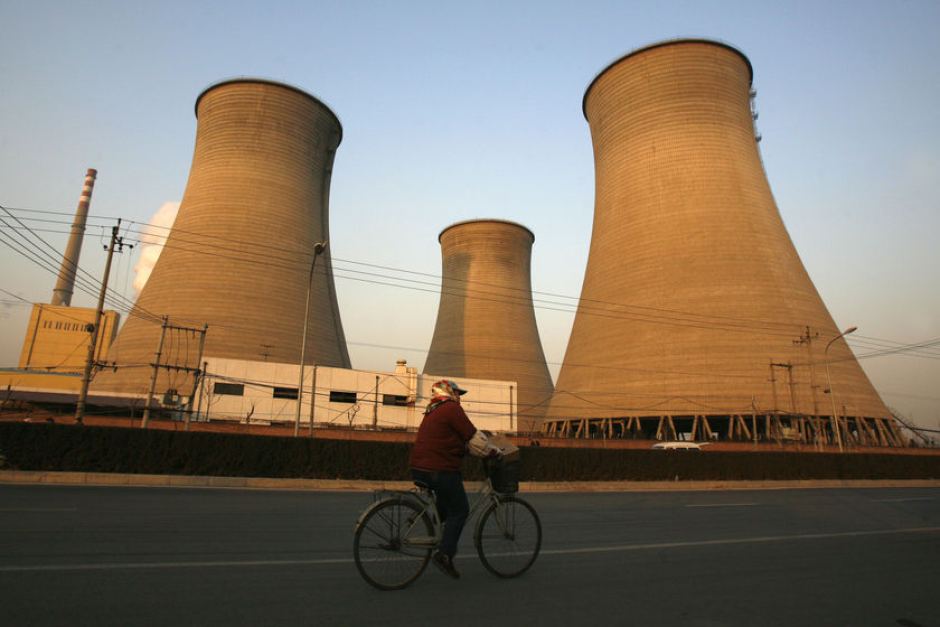
China coal

By the cheers, you’d think that the joint US-China announcement on climate change meant that it was mission accomplished. Job done. Sea level rise, ice melt, crop failure and natural disasters averted.

Of course, it’s nothing of the sort. It’s only the first step on a long, difficult road to fixing climate change. The significance is that they’ve taken that first step. After years of squabbling about who should go first, the USA and China have linked arms and tentatively made a start together.

A quick look at the World Energy Outlook, released this week by the International Energy Agency, illustrates just how rocky that road will be…

Read more http://www.abc.net.au/environment/articles/2014/11/14/4128016.htm


Feral cats force the spotlight onto Australia’s environmental future

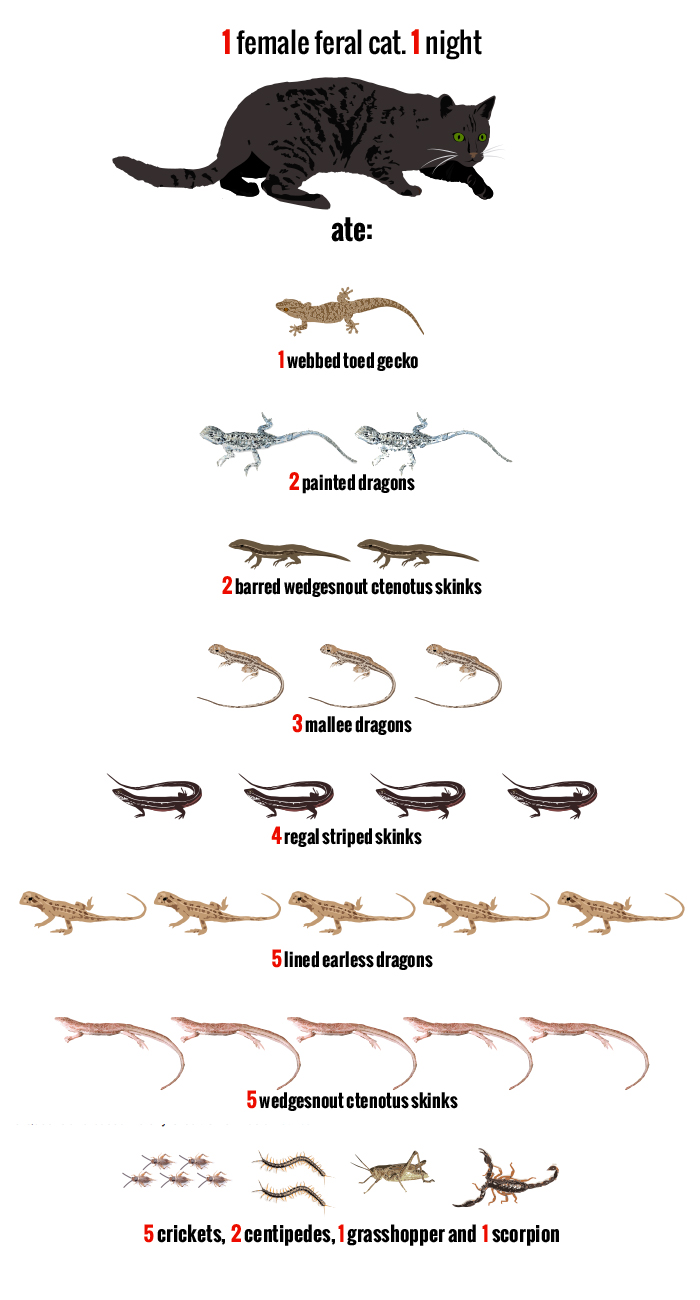
feralcats_feature_illo“ECOSYSTEM MANAGEMENT isn’t rocket science, it’s a lot more complex.” So said Nick Dexter natural resource manager at Booderee National Park on Radio National’s Off Track program more than two years ago.

Nowhere is that more apparent than the problem of feral cats. Scientists tells us that they are causing a new wave of extinction across the Top End; that they kill 75 million Australian animals every single day — more than 27 billion creatures in a year.

But the question of what to do is a lot more nuanced than “shoot ’em”.

Read more… here 

Racking up environmental credit card debt

IMAGINE THERE’S A bright young thing, fresh out of school. Let’s call her Brenda. She’s polished her shoes and worn a nice shirt to the interview and, she’s landed herself a job. Well done Brenda!

Now let’s imagine her starting salary is nothing excessive, but it should be enough to get by comfortably.

And for a while, everything is going well. Brenda is paying her rent on time, she’s putting food on the table, and there’s a little left over for a nice pair of new shoes.

But then, Brenda finds she needs a new shirt. She’s a bit short that month, so she pops it on the credit card. It’s OK, she’ll pay it off next month.

But then she would really like a telly. So she puts that on the credit card too. And she buys some new sheets on the credit card. And while she’s there, a nice set of bedside tables.

Soon, Brenda is racking up some serious debt. Brenda the Spender. But it feels so good to have nice things, and the credit card company doesn’t seem to mind that her bill only grows each month.

If you were Brenda’s parents, or bank, you might start having a word with her about her spending. Older, wiser folk know that living on a credit card is not a sustainable way of life. Many of us did it when we were younger but pretty soon found we were in financial trouble that took years to sort out…

Read more: http://www.abc.net.au/environment/articles/2014/08/04/4059150.htm

The Frankenstein monster that was Australia’s price on carbon

Frankenstein

“You will rejoice to hear that no disaster has accompanied the commencement of an enterprise which you have regarded with such evil forebodings.”

This is the first sentence of a classic novel which I think rather neatly sums up the whole sorry tale of Australia’s carbon tax: Frankenstein.

The original Frankenstein was written by an 18-year-old Mary Shelley in a scary-story-writing competition amongst friends, one rainy summer holiday in 1816.

The more familiar version of Frankenstein is not quite faithful to the original. The inarticulate monster with bolts in his neck (“It’s Aliiiive”) being burned by a mob with pitchforks is the 1930s film reimagining of the original text.

But in all versions the monster is cobbled together from the parts of corpses by Dr Frankenstein…

Read more: http://www.abc.net.au/environment/articles/2014/07/16/4047098.htm